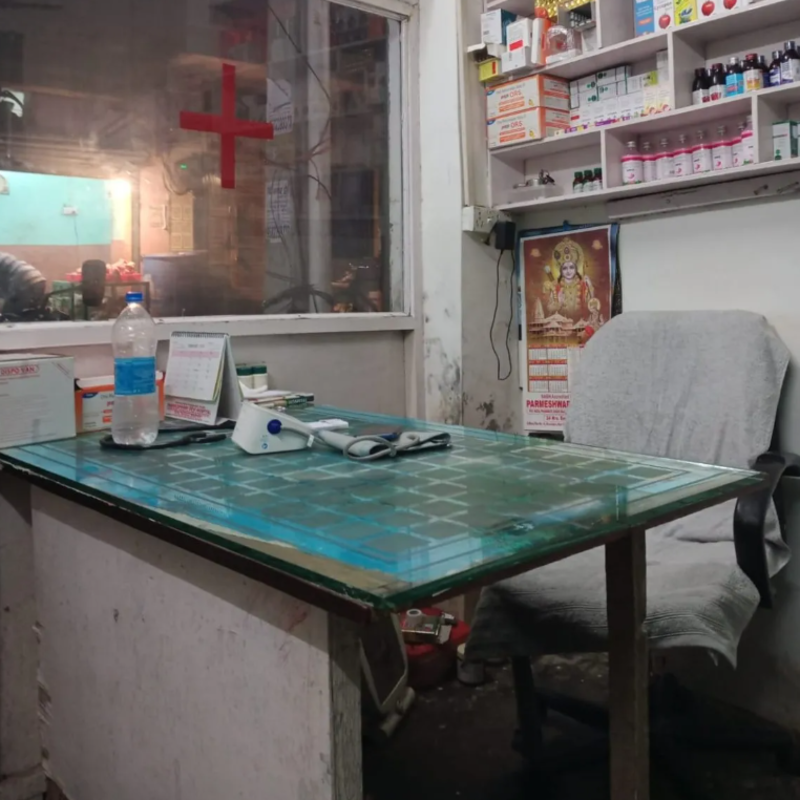
Tanuj Luthra is a doctoral student whose research focuses on the care provided by unlicensed health providers practicing in low-income, informal settlements in Delhi.
Ethnographic Study
In 2022 he began 15 months of fieldwork for his doctoral study. Based in Delhi, he began with semi-structured interviews and surveys with over 50 unlicensed practitioners and hundreds of patients/residents across fourteen low-income neighbourhoods. He then began a rich, place-based engagement in a settlement we know under the pseudonym Unity Colony. Here, he observed hundreds of therapeutic encounters and interviewed practitioners, patients, and medical representatives. He followed up with patients and their families in their homes and also interviewed doctors, staff, and patients at the settlement’s government-run primary health centre.
Unexpected Learnings
During this fieldwork, he encountered unexpected local reflections about the pandemic that diverged sharply from dominant public health accounts. He explores these interpretations in ‘No Covid Here’: Pandemic Afterlives in a Delhi Informal Settlement.
When I began doctoral fieldwork... just over a year after the pandemic’s second wave had ravaged the city, I expected to confront accounts of widespread death and devastation. Yet, during the first weeks of research, I was struck by how people talked about the disease… emphasising its muted impact in their neighbourhood.
Tanuj Luthra 'No Covid Here': Pandemic Afterlives in a Delhi Informal Settlement | 19 February 2026 | Somatosphere
What's more, the mistrust and suspicion between patients and unlicensed practitioners he thought he might find, in mirror of the mistrust in more formal sites of healthcare following Covid-19, not did not emerge.
Instead, the more time I spent at these clinics, the more I found the opposite to be the case.
Tanuj Luthra Conviviality in the Clinic: Exploring the Affective Dynamics of Daktars’ Healthcare Provision in Delhi | 25 February 2026 | South Asia: Journal of South Asian Studies
Prize Winning article
Tanuj’s article Conviviality in the Clinic: Exploring the Affective Dynamics of Daktars’ Healthcare Provision in Delhi is concerned with feelings towards everyday care-seeking encounters with unlicensed health providers in Delhi. It includes ethnographic vignettes that provide a real sense of people's experiences in these clinics.
The essay has won the British Association for South Asian Studies Graduate Essay Prize 2024 and the Society for Anthropological Sciences prize 2025. It is now published in South Asia: Journal of South Asian Studies.
The paper is very much of the moment – it raises issues that are critical to contemporary public discourse, and has valuable policy implications.
British Association for South Asian Studies panellists’ comment on the paper